One memory for the whole fleet
01 /The setup
The agents are not chat windows.
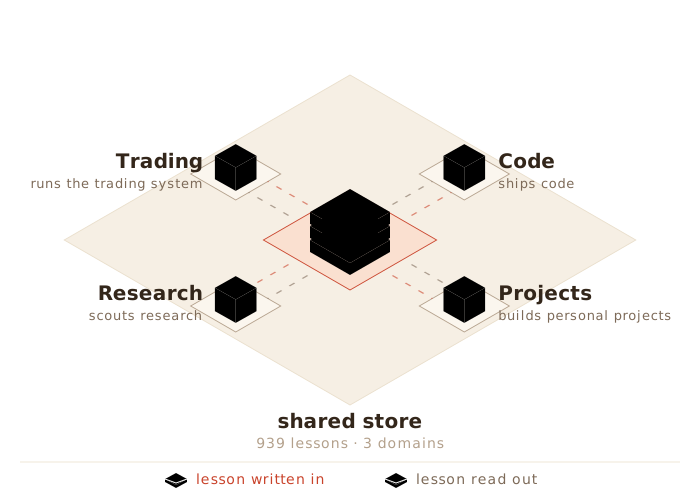
One ships code. One builds personal projects. One scouts research. One runs a trading system.
At first each kept its own notes. A bug one agent had already paid for in production was invisible to the others.
The fix was not a bigger model.
It was plumbing. One store, shared by all of them.
02 /What the store is
Plain on purpose.
- Markdown files are the truth. One file per lesson, with a name, a description, a type, a claim type and an origin.
- The search index is derived from the files. It can be deleted and rebuilt at any time.
- The files live in a git repo. One commit per run, so any run can be reverted.
- Raw material is kept as it came in. Each lesson sits beside it with a pointer back. A summary never replaces its source.
03 /The three stages
Ingest. No model involved. Raw records are stored word for word.
Distill. A model reads the raw records and proposes lessons. It proposes only. It never writes to the store.
Commit. No model involved. This step checks that each proposed lesson points at real raw material, stamps where it came from, and writes it.
Every lesson is marked as a fact or an interpretation. A fact with no source pointer is rejected at commit.
Unverified claims are not dropped. Most engineering knowledge is interpretation, so dropping them would empty the store. They are flagged instead.
04 /Today
The store spans 3 domains: engineer, investor, operator.
Every agent writes to it. Work lessons and personal lessons sit side by side, each tagged work or personal.
Every day, each agent searches the store before researching anything from scratch. If a teammate already learned it, the agent reads the lesson.
One example. An agent about to scrape a travel site found, in seconds, that a teammate had already measured the site's bot wall, the stealth plugin that gets past it, and a pricing quirk.
New research steps spent: 0.
05 /The rule behind it
An autonomous publisher in the fleet once produced a fluent, confident quote that nobody had said. It was made up.
That set one hard rule. An agent runs unattended only when it transcribes. It does not run unattended when it authors.
Anything that summarises or editorialises goes through the same split the store uses: one side proposes, a gate decides, and a human approves what gets saved as learned knowledge.
The store is only as good as its weakest gate. So the gate is mechanical.